Hatsune Miku V6 English Phoneme Guide
BEFORE YOU START
Hatsune Miku V6 is not intended to be realistic, automatically perfect out of the box, or anything akin to modern AI Vocalsynth engines. This is why they didn't put AI in her Voicebank name.
However, her ease of use, tuneability and potential for expression is MUCH higher than any of her previous NT or VOCALOID Voicebanks. In this guide I'll be showing you how to make the most of her English Cross-Lingual capabilities specifically.
VOWEL CONVERSION
Hatsune Miku is voiced by Saki Fujita, who is NOT a native English speaker. This voicebank relies heavily on VOCALOID6's AI converting her Japanese phonetics into English, even with the supplemental (speculative) Miku V4 English data added in there she still has a certain amount of trouble producing fluent English sounds.
This also is not intended to be a "fix" or an "improvement" as keeping her Japanese accent fully intact is an equally appealing process that already sounds pretty good in the first place.
I will add spaces [ ] on the phoneme table to indicate which phoneme should take up the most space on the note. If a conversion is unneeded I'll notate it as such. There will also be points where you'll need to use Japanese phonetics to exaggerate certain dipthongs that become unclear at higher BPMs.
And finally this list is NOT comprehensive, fitting for every situation/song, or treated as "the law". I'm still learning how to use this Voicebank and I will happily take any suggestions or criticisms of this list as they come up & update it accordingly.
| [Phoneme(X-SAMPA/ARPABET)] |
[Conversion] | |
|---|---|---|
| [V]/[ah] | Mostly Unneeded, but [Q] can sound more open at high ranges. | |
| [e]/[eh] | Unneeded | |
| [I]/[ih] | [I][e ] | |
| [i:]/[iy] | Unneeded | |
| [{]/[ae] | [e][{ ][@] | |
| [O:]/[ao] | [O:][Q ] | |
| [Q]/[aa] | [U][Q ] | |
| [U]/[uh] | [U ][e] or [u: ][e] | |
| [u:]/[uw] | Unneeded | |
| [@r]/[er] | Mostly Unneeded, but [@r ][r] or [U][@r ] can work sometimes. | |
| [eI]/[ey] | With Japanese phonemes: [e ][i] | |
| [aI]/[ay] | With Japanese phonemes: [a ][e][i] | |
| [OI]/[oy] | With Japanese phonemes: [o ][i] | |
| [@U]/[ow] | Mostly Unneeded, but [O: ][w] can sound more open at high ranges. | |
| [idk what this one is in x-sampa]/[ix] | [I][@] | |
| [I@]/[iy r] | [i: ][@r] | |
| [e@]/[eh r] | [e ][@r] | |
| [O@]/[ao r] | [O: ][@r] | |
| [Q@]/[aa r] | [Q ][@r] |
CONSONANT CONVERSION
These are mostly fine, but you can get a bit more emphasis/attack out of them if you do a little tinkering.
There is one phoneme that has a labelling quirk at the end, but once you figure out how it works it's pretty easy to take advantage of.
| [Phoneme(X-SAMPA/ARPABET)] |
[Conversion] |
|---|---|
| [r]/[r] | Unneeded, but a [@r] in the leadup to an [r] always helps. |
| [l0]/[l] | Unneeded but [@][l ] works as a replacement for [@l] |
| [v]/[v] | Unneeded |
| [T]/[th] | Unneeded |
| [D]/[dh] | Unneeded |
| [Z]/[zh] | Unneeded |
| [t]/[t] | [t ][s] |
[d]/[d] [4][dx] |
[d ][z] This one's weird, they labeled [t] as a [th] when the consonant is large and a [4] when it's timed to be small, so edit the phoneme timing and make it barely take up any space and it'll sound out a [4] |

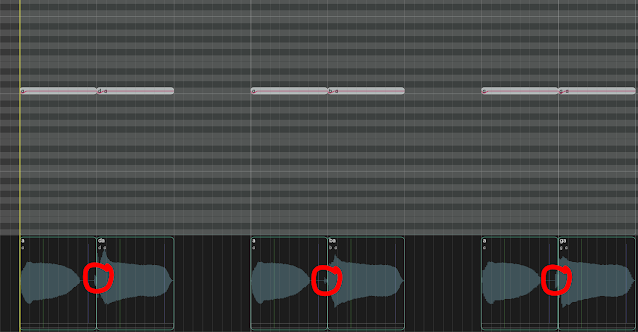
I like to add the "j" phoneme after "I" for a clearer pronunciation
ReplyDelete